Multi-Currency Treasury Banking for UAE Businesses Expanding Internationally
UAE businesses expanding internationally often manage revenue, supplier payments and operating costs across multiple jurisdictions. For multinational groups, holding entities, family offices, and foreign-owned entities, this can mean dealing with different banking relationships, FX rates and cross-border payments while maintaining visibility over funds.
As the number of currencies, counterparties and entities grows, these treasury operations become harder to manage through a standard AED-focused business account. Multi-currency treasury banking addresses this need by giving internationally structured businesses a more practical way to manage their global financial operations while remaining based in the UAE and supporting continued expansion into new markets.
What Multi-Currency Treasury Banking Actually Involves
Multi-currency treasury banking combines multi-currency banking with treasury management. A multi-currency business account in the UAE allows a business to hold, receive and pay funds in several currencies while supporting currency conversion through one banking relationship. In contrast, treasury management for UAE businesses goes further by helping them manage these balances and cash flows through liquidity management, cash concentration and cash flow forecasting as part of their wider cash management and treasury operations.
This distinction is particularly relevant for UAE businesses with multi-entity ownership structures and multi-jurisdictional operations, where funds may need to be managed across parent companies, subsidiaries and, where applicable, Special Purpose Vehicles (SPVs) in different currencies.
Why UAE Businesses Face Specific Treasury Challenges When Expanding Internationally
UAE businesses expanding internationally usually face three main treasury challenges: managing heavy international trade exposure, mitigating growing geopolitical risks, and navigating strict banking compliance and complex ownership structures.
Growing International Trade Exposure
The UAE ranks first in the Arab world and third globally for re-exports. This central role means even locally domiciled companies quickly develop complex international banking requirements, connecting them to customers, suppliers, and markets across the GCC and the globe very early in their growth cycle.
Moreover, local businesses, family offices and high-net-worth-individuals may have supply chains, investments and liquid assets spanning Europe, the UK, the US and other international markets. This creates treasury needs across multiple currencies and jurisdictions.
Geopolitical Risk and Business Continuity
The regional conflict that escalated on 28 February 2026 has created immediate economic and operational disruption, with estimates pointing to $63 billion in regional losses within two weeks and a projected 3.2-percentage-point downgrade to UAE GDP growth.
For internationally active businesses, concentrating capital infrastructure within a single Gulf jurisdiction can increase exposure to such regional disruption. This creates a need for multi-currency treasury banking that supports jurisdictional diversification and more resilient cross-border capital infrastructure, when expanding internationally.
Complex Ownership Structures and Regulatory Compliance
Many expanding UAE businesses operate with complex corporate structures, foreign shareholders and non-resident directors. Under Central Bank of the UAE (CBUAE) guidelines, regulated financial institutions conduct customer due diligence when establishing business relationships and may request information on ownership, beneficial owners, business activities and expected transactions as part of Anti-Money Laundering (AML) and Know Your Customer (KYC) compliance checks.
As documentation requirements and risk appetite vary between providers, choosing a banking partner that can accommodate the company’s ownership structure and international operations becomes an important part of building the right treasury setup.
Providers For Multi-Currency Treasury Banking
For UAE businesses expanding internationally, transitioning from a standard corporate account to a multi-currency treasury setup generally involves choosing between three main options: traditional banks, digital-first regional banks and specialist fintech account providers.
Traditional Business Banking
Major UAE banks such as Emirates NBD, FAB, ADCB and Mashreq combine physical branch support with comprehensive credit, trade finance and corporate treasury capabilities, making them a suitable option for established single-jurisdiction mainland and large free zone companies with high transaction volumes, substantial import/export requirements or structured lending needs. However, stringent anti-money laundering compliance, higher minimum balance requirements and extensive documentation can lead to longer account approval timelines, particularly for complex and non-resident structures.
Digital-First Business Banking
Digital banks such as Wio Bank and Zand provide app-based account management and streamlined digital onboarding, making them particularly relevant to UAE SMEs and businesses with relatively straightforward ownership structures. Depending on the account, businesses may access payment links, multi-currency holdings, and FX services without relying heavily on a branch network. However, they may be less suitable for large corporations, complex holding entities or businesses requiring manual compliance reviews and dedicated relationship management.
Specialist Business Account Providers
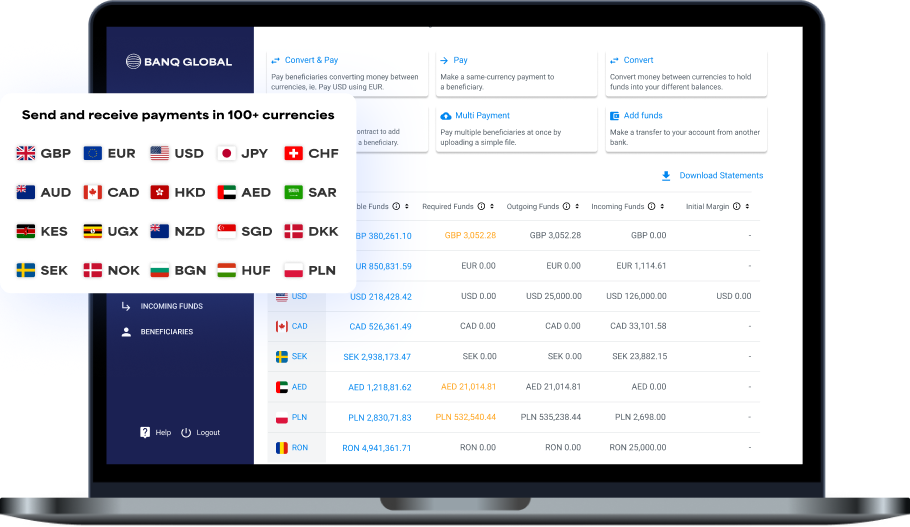
Specialist providers such as Banq Global, are designed for internationally structured and non-resident businesses with complex ownership structures that may not fit standard banking models. Depending on the provider, they can offer a multi-currency wallet, broad currency coverage, and competitive FX services through a single platform. These capabilities can support B2B cross-border payments, intercompany transfers, global payroll and mass payouts across multiple markets, while providing finance teams with greater visibility over international balances for Liquidity management and Cash flow forecasting.
What to Look For in a Multi-Currency Treasury Solution
When evaluating a multi-currency treasury banking solution for a UAE business expanding internationally, your treasury dashboard must serve as a centralized command center that simplifies cross-border complexities.
Broad Currency Coverage
Make sure the platform supports holding, converting, and managing major global currencies alongside Dirham (such as USD, EUR, GBP, and 100+ others). Some international business banking platforms in the UAE support 150+ currencies, although the currencies availability may differ by provider
Local-Country IBANs
Look for solutions offering local Account Details and IBANs. Compared with named virtual IBANs, local country IBANs allow overseas customers to make domestic payments in supported markets, reducing reliance on correspondent banks and intermediary banks for eligible transactions.
Real time FX Rate & Hedging Tools
Look for transparent real-time FX rates with clearly disclosed FX spreads, so you can understand the cost of each currency conversion. If your business has regular currency exposure, also check whether the provider offers FX hedging tools such as forward contracts, FX rate locks and market orders.
International and Local Payment Rails
Confirm whether the platform supports both SWIFT payments and local payment rails in the markets where you operate. Access to international wire transfers alongside domestic clearing networks can give UAE businesses more flexibility for cross-border payments.
Non-Resident Directors & Complex Ownership
Choose a provider experienced in handling complex ownership structures and non-resident directors. This is particularly important for holding companies and SPVs established in DIFC or ADGM, which may require more detailed KYC and ownership checks.
Onboarding Speed & Account Management Support
Compare onboarding timelines and the level of support available, from digital self-service to a dedicated relationship manager. Internationally structured businesses may benefit from dedicated support when dealing with complex documentation and account requirements.
Consolidated Visibility & Reporting
Look for consolidated visibility across accounts, currencies and entities, alongside real-time transaction data and audit-ready transaction records. Clear transaction records can help finance teams track supplier and procurement payments while providing the financial data needed to support VAT reporting and cross-border tax reporting.
For businesses expanding internationally, multi-currency treasury banking with API-driven treasury connectivity can also help integrate banking data with existing ERP or accounting systems.
How Banq Global Supports UAE Businesses Expanding Internationally
Banq Global provides a specialist multi-currency treasury banking option for internationally structured UAE businesses, with priority onboarding for family offices, multinational groups, holding entities, foreign-owned entities and businesses with non-resident directors and shareholders. Its key capabilities include:
Fast and Digital Setup
Provides digital onboarding with dedicated support for complex and internationally structured businesses.
Multi-Currency and Local Access
Access to 130+ currencies alongside local country IBANs issued in the company’s name.
Multi-Entity Treasury Visibility
Provides consolidated visibility across entities and accounts, helping finance teams monitor balances, cash flows and intercompany transfers from a centralised platform.
FX Risk Management
Provides real-time FX capabilities and currency risk management tools, including forward contracts and limit orders, to support businesses managing international currency exposure.
Global Payments
Supports payments to 190+ countries, including local payment rails, mass payments and batch payment capabilities for international treasury operations.
Personalised Service
A dedicated account manager provides ongoing support with onboarding, account requirements and cross-border treasury needs.
It is important to note that while Banq Global supports complex, multi-jurisdictional structures, a simple, single-jurisdiction domestic business may be better served by a traditional bank.
FAQs
Can a non-resident-owned UAE business open a multi-currency account when expanding internationally?
Yes, multi-currency treasury banking is available for UAE businesses with non-resident directors, subject to the provider’s eligibility, KYC and customer due diligence requirements. While some traditional banks require a local presence or additional scrutiny for foreign ownership, specialist providers may be more experienced in accommodating these structures.
What documents are required to open a multi-currency treasury account for a UAE business?
Requirements vary by provider and company structure, but commonly include a valid trade licence or certificate of incorporation, MOA/AOA, board resolution where applicable, identification for shareholders and authorised signatories, proof of business address and recent bank statements. Additional KYC documents may be required for non resident or complex ownership structures.
How long does it take to open a multi-currency business account for a UAE company?
Timelines vary by provider and company profile. Some UAE banks can process eligible business account applications within one or a few days, while complex ownership structures and additional KYC checks may extend the timeline. Specialist providers may also offer faster digital onboarding for eligible businesses.
What are the typical fees for multi-currency treasury banking in the UAE?
Fees vary by provider and account package but may include monthly account fees, minimum-balance charges, international transfer fees and FX conversion costs. Businesses should compare both transaction charges and FX rates or spreads when evaluating the overall cost of multi-currency treasury banking when expanding internationally.
Who regulates financial services in the UAE?
The Central Bank of the UAE (CBUAE) regulates banks and certain financial institutions, while financial services in Abu Dhabi Global Market (ADGM) are regulated by the Financial Services Regulatory Authority (FSRA). The Dubai Financial Services Authority (DFSA) regulates financial services in the DIFC.
Is Banq Global regulated, and how are client funds protected?
Banq Global operates through regulated financial partners, including FCA-authorised Electronic Money Institutions. Client funds are held in segregated, safeguarded accounts through its regulated partners. Banq Global also provides additional financial services, including escrow account services, for businesses with more complex requirements.