Opening a Business Account in the UAE: Everything You Need to Know
The UAE is strengthening its position as a global trade hub, with non-oil foreign trade reaching AED 1.937 trillion in the first half of 2026, up 13.1% year on year, while non-oil exports rose by 23.9% as well, reaching a record AED 452.8 billion. This scale of international activity creates a growing need for banking infrastructure that connects businesses with local and global markets. A UAE business account can support Dirham settlement, multi-currency transactions and cross-border payments, including international transfers routed through correspondent banks. Opening a business account in the UAE, however, involves compliance reviews based on the company's ownership structure, business activity, source of funds and expected transaction flows.
Which UAE Entity Structure You Need Fits
The entity structure and jurisdiction you choose determine where the business can operate, the activities it can conduct and the requirements it must meet. These choices also affect the documents and ownership information an account provider will assess when opening a UAE business account. Therefore, the business must be established and registered before opening a business account in the UAE.
Mainland Companies
These entities are licensed to conduct business onshore (outside the free zones). The Department of Economic Development (DED), or the equivalent economic authority, licenses these businesses in each emirate. In Dubai, the Department of Economy and Tourism (DET) handles this role.
Most commercial and industrial activities allow 100% foreign ownership without a local sponsor. Activities with a strategic impact may still require special government approvals or local ownership arrangements.
Businesses generally need physical office space and a registered lease agreement to maintain their licence. This structure is generally suited to businesses that trade directly with customers and companies across the UAE.
Free Zone Companies
UAE free zone companies are business entities licensed within designated economic zones that generally permit 100% foreign ownership and operate under their respective free zone authorities. Examples include DMCC, IFZA and RAKEZ, with each free zone having its own rules and permitted business activities.
If a company wants to trade directly on the UAE mainland, additional requirements may apply. Depending on the emirate and activity, this can include obtaining an additional licence or permit or working through an authorised local distributor.
This structure is generally suited to international trading, professional services, technology and businesses focused on cross-border operations.
Offshore or IBC structures
RAK ICC and JAFZA Offshore provide international business company (IBC) structures designed for holding assets, managing investments and conducting international business outside the UAE mainland market. Each offshore jurisdiction sets its own permitted activities and requirements, including rules governing physical premises and the ability to employ staff in the UAE. This structure is generally suited to holding companies, investment structures and businesses managing assets across multiple jurisdictions.
Financial Free Zones: DIFC and ADGM
DIFC and ADGM are specialised financial free-zone jurisdictions in Dubai and Abu Dhabi where businesses can establish legal entities for financial, investment and private wealth activities. Unlike an entity type themselves, they provide the legal and regulatory environment in which structures such as funds, holding companies, family offices and special purpose vehicles (SPVs) can be established.
Both operate common-law-based legal systems with their own courts and financial regulators. DIFC has a well-established ecosystem of international banks, asset managers and investment firms, while ADGM directly applies English common law and has developed frameworks covering areas such as private wealth and digital assets.
Who Actually Needs a UAE Business Account
Whether a business needs to open a business account in the UAE depends on its activities and the transactions it expects to manage.
UAE Operating Companies
To collect customer payments, pay suppliers and employees and manage day-to-day transactions in AED.
Holding Companies and SPVs
To receive investment income and manage payments related to regional assets or subsidiaries.
International Groups
To settle transactions in AED and manage financial flows between UAE operations and other markets.
Family Offices
To manage investment flows, operating expenses and assets held across UAE and GCC structures.
However, not every business will need to open a corporate bank account or business current account in the UAE. Companies with occasional AED conversion or limited local transactions may find an appropriate multi-currency platform sufficient for their needs.
The Three Ways to Open a Business Account in the UAE
Businesses generally have three options for opening a Business account in the UAE: traditional banks, digital-first banks and specialist providers. The right choice depends on how the business operates, the services it needs and the types of transactions it manages.
Traditional Banks
Traditional banks such as Emirates NBD, First Abu Dhabi Bank (FAB) and Mashreq offer full-service business accounts with access to local and international payments, multi-currency accounts, lending, trade finance and treasury services, making them well suited to established companies involved in high-volume domestic trading. However, banks may require additional corporate documents, in-person verification and detailed checks on beneficial ownership, source of funds and expected account activity, particularly for businesses with complex or layered ownership structures.
Digital banks
Digital-first UAE banks such as Wio Bank, Zand and Mashreq NEO offer app-based business banking, digital onboarding and streamlined account management. Applications and day-to-day banking can generally be handled online, reducing the need for branch visits and manual paperwork. However, their lending, trade finance and more advanced corporate banking services may be more limited than those offered by traditional banks, making digital banks a suitable option for businesses with straightforward ownership structures and standard banking needs.
Specialist Account Providers
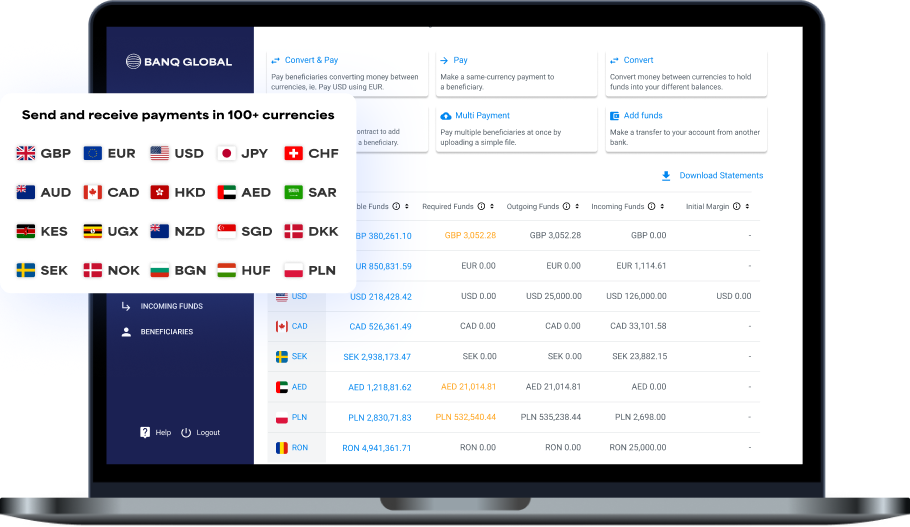
Specialist providers such as Banq Global are designed for established international businesses with more complex banking requirements, including holding companies, group structures, funds and family offices. They focus on areas such as multi-currency accounts, cross-border payments and FX, while taking the wider ownership structure and expected payment flows into account during onboarding. This makes them particularly relevant where a business operates across multiple jurisdictions or does not fit the standard profile of a traditional or digital bank.
Documents You'll Need For Open a Business Bank Account in UAE
The Central Bank of the UAE (CBUAE) sets Customer Due Diligence (CDD) and Know Your Customer (KYC) obligations, while individual banks determine the exact documents needed to satisfy them. Therefore, business bank account requirements in the UAE vary depending on the business activity, ownership structure and risk profile, but commonly include:
Company Documents
- Trade licence or Certificate of Incorporation
- Memorandum of Association (MOA)
- Articles of Association (AOA)
- Corporate Tax Registration Number (TRN), where applicable.
Ownership and Signatory Documents
- Director and shareholder passports (Emirates ID where applicable).
- Board resolution naming the authorised signatories.
- Power of Attorney (POA), where applicable.
- Organisation chart and Ultimate Beneficial Owner (UBO) documentation for businesses with layered ownership structures.
Address and Premises Documents
Proof of the registered UAE business address, such as an Ejari, tenancy contract or relevant free-zone tenancy or lease agreement.
Financial Documents
- Six-month bank statements for existing companies.
- Source of Funds (SoF) documentation.
Business Activity Documents
Business plan or company profile covering the nature of the business and expected transaction volumes. Account providers may also request contracts, invoices or other evidence supporting the expected account activity to open a UAE business account.
Step by Step Process For Opening a Business Account in UAE
The Process of opening a corporate bank account in the UAE involves a standard five-step sequence from legal setup to final account activation.
Step 1: Entity Registration
Before applying for a business account, register your mainland, free zone or offshore entity with the appropriate authority. International businesses, funds, holding companies, SPVs and family offices may also establish appropriate entities within DIFC or ADGM.
Step 2: Provider Shortlisting
Instead of applying broadly, shortlist two to three financial providers that match your business profile to avoid unnecessary credit checks and administrative work.
Step 3: Application & Document Submission
Submit your formal application alongside required corporate documentation. Depending on the provider, this is handled either via an online portal or in-person at a physical branch.
Step 4: Compliance & KYC Review
During this phase, the provider conducts Know Your Customer (KYC) and Anti-Money Laundering (AML) checks. Identity verification may be completed digitally through e-KYC, by video KYC or through an in-person check, depending on the provider.
Step 5: Activation & First Deposit
Once the compliance team approves the application, the account is officially activated and the business receives its account details, including its IBAN where applicable. The business can then make its first deposit and begin using the account for payments and other transactions.
Costs to Expect when Opening a Company Account in the UAE
The cost of opening a business account in the UAE varies depending on the provider, account tier and how the business plans to use the account.
Minimum Balance
Requirements vary significantly. Current business account packages from major UAE banks range from around AED 10,000 to several million dirhams, depending on the account tier. Some digital and specialist providers offer accounts without a minimum balance requirement.
Account Fees
Monthly maintenance, subscription or fall-below fees may apply depending on the provider and whether the required balance is maintained.
International Payments
SWIFT transfers may carry transaction and correspondent banking charges, while non-AED payments can also include FX mark-ups. Businesses handling frequent cross-border payments should therefore compare the total transfer and currency-conversion cost rather than the headline account fee alone.
Application Timeline
Account-opening timelines depend on the company profile, required due diligence and provider. Some digital banks advertise account opening within one to three working days for eligible businesses, while specialist account providers can complete straightforward applications within a few working days. Traditional banks also increasingly support digital applications to streamline onboarding.
Regardless of the provider, more complex applications may take longer where additional documentation, ownership checks or detailed compliance reviews are required.
What UAE Banks Actually Look At During Compliance Review
Account providers must comply with anti-money laundering (AML) and counter-terrorism financing (CTF) requirements when reviewing applications to open a business account in the UAE. Because non-compliance can result in significant regulatory penalties, banks apply detailed compliance checks rather than treating the process as a documentation formality. The level of scrutiny depends on several factors:
Jurisdiction and Residency Risk
Account providers review where the company's Ultimate Beneficial Owners (UBOs), directors and authorised signatories live and where the businesses in the ownership structure are registered. Connections to sanctioned countries or high risk jurisdictions identified by the FATF can lead to additional checks. Parent companies or subsidiaries registered in offshore jurisdictions may also receive closer review, particularly where the ownership structure is difficult to trace.
Business Activity Risk
Activities with greater exposure to money laundering or financial crime may require more supporting evidence. These can include general trading, cryptocurrency and digital assets, gold and precious metals, real estate and cash-intensive businesses. More straightforward activities, such as consultancy and IT services, may face a simpler review, although each application is assessed individually.
Ownership and Corporate Structure
Multi-layered companies, trusts and holding companies operating across several countries can require additional checks because the bank/account provider must trace the ownership chain to the Ultimate Beneficial Owner (UBO). Banks may also consider the commercial reason for the structure and evidence of UAE operations, such as an office or Ejari, employees or clear local business activity.
Source of Funds and Wealth
Before opening a business account in the UAE, account providers also need to understand where the company's money comes from and, where relevant, how its owners built their wealth. They also check whether expected transactions are consistent with the company's stated business activity. Businesses involved in international trade may face additional checks to confirm that their payment flows match their customers, suppliers and trading markets.
It's important to note here that approaching multiple account providers simultaneously without first addressing these fundamental compliance issues is unlikely to resolve the underlying reasons for delays or application rejection.
Business Bank Account UAE Requirements For Non-Resident Directors and Shareholders
Non-resident directors and shareholders can be part of a UAE company applying for a corporate bank account. Account providers will verify the ownership structure, UBOs, business activity and authorised signatories, with additional checks for higher-risk applications. In-person verification may also be required by some providers.
For more detail, see our guide to opening a business account in the UAE as a non-resident.
FAQs
What's the difference between a mainland, free zone, and offshore company account?
- A mainland company can conduct business across the UAE and is licensed by the relevant emirate's economic authority.
- A free zone company can operate within its free zone and internationally, while direct mainland activity may require additional licences or approvals.
- Offshore companies are generally used for holding assets, investments and international business rather than conducting local UAE operations.
Are DIFC and ADGM Free Zone Companies?
No. DIFC (Dubai International Financial Centre) and ADGM (Abu Dhabi Global Market) are specialised financial free zones and separate legal jurisdictions, not companies themselves. International businesses can establish different corporate vehicles within them, including holding companies, Special Purpose Vehicles (SPVs), investment funds, private wealth structures, operating companies and regulated financial firms.
Do I need a trade licence before I can open a business account in the UAE?
A trade licence is one of the documents issued when registering certain types of UAE entities, but not every entity receives one. Mainland and operating free zone companies generally receive a trade or business licence, while offshore entities and certain DIFC and ADGM structures receive other registration or licensing documents. These documents must then be submitted as part of the application before opening a business account in the UAE.
Which type of provider is best for a business account in the UAE?
A traditional bank may suit established companies with high-volume domestic transactions and trade finance needs. Digital-first banks and neobanks can work well for businesses with straightforward ownership and standard banking requirements. Internationally structured businesses with complex ownership, multi-currency needs or frequent cross-border payments may benefit from a specialist provider.
Is it illegal to use a personal account for business in the UAE?
Not necessarily, but a personal account should not generally be used for company transactions. UAE banks assess the purpose and expected activity of accounts through Customer Due Diligence (CDD), including Know Your Business (KYB) checks for corporate customers. Using a personal account for business activity may breach the bank's terms or trigger additional compliance checks.
What causes UAE business account applications to be rejected?
Applications may be rejected because of incomplete KYC documents, unclear Source of Funds, unverifiable UBO information or inconsistencies between the stated business activity and expected transactions. A provider may also decline businesses that fall outside its risk appetite.