According to the Triennial Survey by the Bank for International Settlements conducted with Danmarks Nationalbank, around DKK 680 billion is traded daily in Denmark’s foreign-exchange market, making it the 13th largest FX market in the world. This activity is supported by a robust banking system with strict anti-money laundering (AML) and know-your-customer (KYC) regulations, which are particularly demanding for foreign-owned companies and international entrepreneurs opening a business bank account in Denmark, contributing to rejection rates of 30–50%. To improve the chances of approval, non-resident directors or authorised signatories must provide detailed corporate documents, identification records for beneficial owners, and proof of business activity. Banks may also require additional verification before granting access to local banking services.
Why Do Non-Residents Need a Danish Business Account?
International companies conducting business in Denmark often require a local business bank account to manage financial operations efficiently. A Danish bank account enables companies to:
- Receive payments in Danish krone (DKK) from local clients
- Pay Danish suppliers and service providers directly
- Meet local accounting and tax compliance obligations
- Build credibility with Danish authorities and business partners
Many Danish counterparties prefer working with companies that hold a local account in Denmark, particularly when entering supplier agreements or government contracts.
For foreign-owned subsidiaries, investment vehicles, or multinational companies expanding into Denmark, a local business account simplifies daily operations and improves integration into the Danish financial system.
Common Challenges Non-Residents Face When Opening a Danish Business Account
Non-residents face extra regulatory checks, making opening a business account in Denmark more difficult and often described as a "Catch-22," especially when directors or shareholders live outside Denmark. Common challenges include:
Local Presence and Registration Requirements
Banks often require a Danish CVR number, a local address, and sometimes a Danish CPR number for directors. These requirements are hard to meet without a local presence, creating a major obstacle for non-resident businesses and international entrepreneurs.
Limited Options for Non-Residents
Many traditional banks rarely offer Danish business accounts to non-residents, limiting access for foreign entrepreneurs. While waiting for a local account, companies often face delays in starting operations because of restricted banking options and strict eligibility rules.
Documentation and Compliance Requirements
Applicants must provide corporate documents, identification for beneficial owners, and proof of business activity. Non-resident businesses face strict AML and KYC regulations, making the paperwork extensive, complex, and time-consuming.
Operating History and Business Proof
Most banks want to see 3–6 months of trading history before approving bank accounts in Denmark. New foreign-owned companies often cannot meet this requirement, making it difficult to demonstrate legitimacy without an active local account or business registration number.
Physical Verification and Due Diligence
Some banks require physical presence of directors for identity checks. Non-resident businesses with international shareholders or holding entities are frequently subject to enhanced AML and KYC checks, adding further layers of compliance scrutiny.
High Costs and Extended Timelines
The onboarding process can take weeks or months, with most banks charging high setup fees along with hidden fees. Some institutions also require annual audits costing 20,000–50,000 DKK to open new Danish business accounts, making the process expensive and resource-intensive for international entrepreneurs.
CVR Registration and When Non-Residents Need a Danish Entity
As mentioned above, CVR registration is one of the key hurdles non-residents must overcome before opening a Danish business account. To proceed, non-resident companies must register with the Danish Business Authority (Erhvervsstyrelsen) to obtain a unique 8-digit CVR number (corporate identification number).
- Registration involves establishing a subsidiary, branch, or limited company such as an ApS, and is completed online via the Virk.dk platform.
- Limited companies must meet minimum capital requirements to qualify for registration: DKK 40,000 for an ApS and DKK 400,000 for an A/S.
- The registration process must be handled by someone with a MitID (Danish digital ID), usually a local advisor.
- Registration can take anywhere from a few hours to several weeks depending on whether it is submitted online or on paper.
For companies without a Danish entity or CVR number, fintech platforms offer an alternative by providing fully digital multi-currency IBAN accounts. These accounts support basic transactions, multi-currency payments, and receiving money internationally, though they generally do not provide lending or full corporate banking services.
CPR, MitID and Identity Requirements for Non-Residents
Just as a CVR number officially registers the company, a CPR number (Central Person Register) is required for identity verification of international founders and non-resident directors when opening a Danish business account. This typically involves:
- A Danish address
- A residence permit or work permit
- Registration at the International Citizen Service (ICS) using a passport, residence permit, and proof of address (if living in Denmark for over three months)
- Access to MitID, which can be obtained at a Citizen Service Centre using a passport and a witness, or via a foreign eID for EU/EEA citizens.
Some financial institutions allow remote onboarding, but most traditional banks still require in-person verification to complete identity checks and activate a Danish business account.
Banking Options for Non-Resident Directors: Choosing the Best Business Bank
When planning to open a business account in Denmark as a non-resident, choosing the right business bank is essential to comply with Danish regulations and anti money laundering requirements. The best option depends on:
- Residency status of directors and shareholders
- Corporate ownership structure
- Need for multicurrency accounts
- Expected international payment activity
- Speed of onboarding requirements
International businesses typically choose between traditional Danish banks, fintech business accounts, or specialist account providers.
Traditional Danish Banks
For non-resident founders seeking a Danish business bank account, traditional banks offer the most comprehensive corporate banking services and remain the preferred option for companies with a genuine local presence. Examples include Danske Bank and Jyske Bank, which provide access to full corporate banking services, including lending facilities, direct access to local payment infrastructure, and dedicated corporate relationship managers.
These banks require extensive corporate documents, financial statements, a detailed business plan, and proof of local operations. Physical presence of directors or authorised account holders is often mandatory, alongside compliance with strict anti-money laundering and KYC requirements. Traditional banks are best suited for larger businesses, foreign entrepreneurs, and companies with a Danish business registration number seeking a robust Danish business account.
Fintech Business Accounts
Digital banking platforms have emerged as a popular alternative for international entrepreneurs and non-resident businesses needing multi-currency accounts and faster onboarding. Providers such as Wise Business offer online banking, support for international payments, and accounts capable of holding multiple currencies, enabling easier currency exchange and cross-border transactions.
Fintech platforms allow remote account opening without the immediate need for a CVR number or Danish CPR number, making them suitable for non-EU residents and companies expanding operations in Denmark. However, fintech accounts typically do not offer lending products or the full spectrum of services available at traditional Danish banks, making them ideal for small businesses, sole proprietorships, or investment vehicles primarily focused on receiving money and paying suppliers internationally.
Specialist Business Account Providers
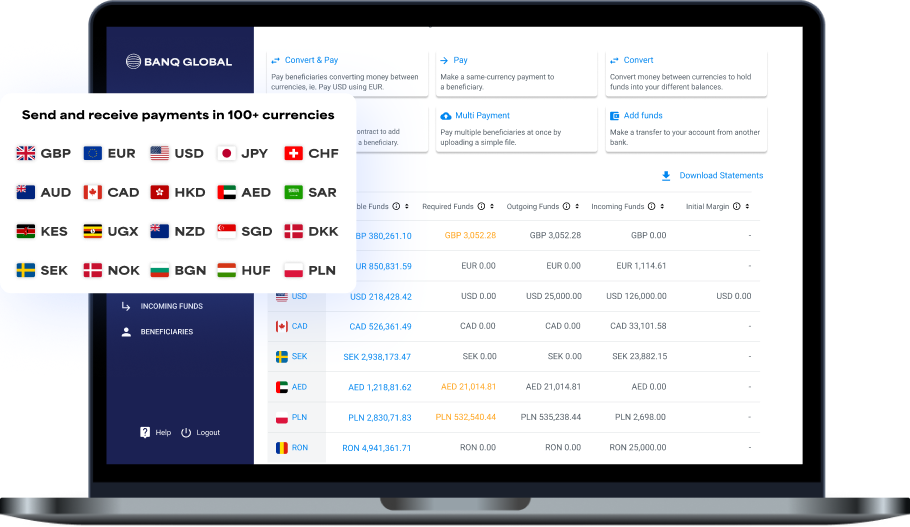
Specialist business account providers cater specifically to non-resident directors, international entrepreneurs, and companies with complex ownership structures, including foreign-owned Swedish companies, limited partnerships, and multinational groups. Banq Global works with both traditional banks and fintech providers to streamline account access, offering multicurrency business accounts, global payment infrastructure, and support with compliance documentation.
These providers are particularly valuable for companies operating across multiple jurisdictions, investment vehicles, and founders seeking guidance with capital requirements, corporate documents, and beneficial owner identification. Specialist providers combine the flexibility of remote onboarding with the regulatory support needed to successfully open a business account in Denmark without a local presence.
Document Checklist Before Opening A Danish Business Bank Account
Identity Documents
Passport or national photo ID of directors, shareholders, and authorised signatories
Company Registration Proof
- Danish CVR number (business registration number)
- Certificate of incorporation
Proof of Danish Address
- Utility bills
- Lease agreements or rental contracts
Corporate Documents
- Articles of association
- Memorandum of association
- Shareholder agreements
- Board resolutions authorising the account
- Power of attorney if using a representative
Financial & Business Documents
- Business plan and forecasts
- Cash flow projections
- Profit and loss statements
- Balance sheet forecasts
Proof of Source of Funds
Documents showing the origin of the business capital
Legalisation and Translation
Apostille or notarisation for:
- Certificate of incorporation
- Articles of association
- Power of attorney
- Passport copies of directors and shareholders
Certified translation into Danish or English if originals are in another language
Steps to Open a Business Account in Denmark as a Non-Resident
Here are the step-by-step instructions for international entrepreneurs, foreign business owners, and non-resident directors to make the process of opening a business account in Denmark smoother and more organised, increasing their chances of approval.
Decide Your Business Type
Choose your business structure, such as a sole proprietorship, limited partnership, or ApS.
Register with the Danish Business Authority
Obtain a CVR number by registering your company with the Danish Business Authority.
Prepare Corporate and Supporting Documents
Gather all necessary documents, including identification records for directors and beneficial owners.
Legalize and Translate Documents
Ensure all documents are legalized and translated into Danish or English. Apostille certification may be required for foreign-issued documents.
Obtain CPR Number and MitID
Get a CPR number and access to MitID if required for account verification.
Choose a Banking Option
Select between traditional banks, fintech business accounts, or specialist providers.
Submit Application and Complete Compliance Checks
Provide all documentation and complete the bank’s compliance and due diligence requirements.
Activate Your Multi Currency Account
Once approved, set up your account for online banking, multi-currency transactions, and international payments.
Why Do Non-Resident Companies Often Need Multicurrency Accounts?
For international entrepreneurs, foreign business owners, and non-resident directors, multi currency accounts are essential when operating business in Denmark across multiple jurisdictions. These accounts allow companies to hold balances in major currencies, manage currency exchange, and efficiently receive payments from global clients while making international payments to suppliers.
FX tools help monitor exchange rates, reduce conversion costs, and streamline financial operations. Choosing the right provider ensures smooth online banking, better control over funds, and cost-efficient cross-border transactions for companies opening a business account in Denmark.
Banq Global’s Danish Business Account for Non-Residents
Banq Global simplifies banking for international entrepreneurs, foreign business owners, and non-resident directors in Denmark by offering fully digital multi currency account opening without requiring a Danish CPR number or local company registration.They offer:
- Fast, remote onboarding through partner institutions
- Dedicated account manager support for compliance and documentation
- Assistance with compliance documentation and regulatory requirements
- Overcoming local presence obstacles and reducing onboarding delays
These solutions are ideal for multinational groups, foreign subsidiaries, and international investment structures, enabling smooth financial operations across multiple jurisdictions.
FAQs
What are the business types and capital requirements for non-residents in Denmark?
Non-residents can register a sole proprietorship, private limited company (ApS), public limited company (A/S), or limited partnership. Limited companies provide limited liability and require minimum share capital of DKK 40,000 (ApS) or DKK 400,000 (A/S), while sole proprietorships and limited partnerships usually have no minimum capital for your own business.
What is a CPR number and why is it needed for opening a Danish business account for non-residents?
CPR number is Denmark’s national identification number, serving as a tax identification number (TIN). It is essential for working, banking, and obtaining a tax card, and is required by most traditional banks when you need to open a bank account in Denmark.
What ongoing compliance is required for non-resident businesses in Denmark?
Non-resident companies with a Danish business bank account must:
- Submit annual financial statements
- Update corporate documents
- Report changes in directors or shareholders
- Complete periodic AML/KYC checks
Do non-resident companies need to register for VAT in Denmark?
Yes. Registration is required immediately upon taxable activity via the Virk.dk portal. The SE-nummer is used for VAT reporting and is often the same as the CVR number. Maintaining VAT registration is important for operating a Danish business bank account and ensuring smooth payments and compliance.
Can compliance and tax obligations be handled remotely?
Yes. Many fintech platforms and specialist providers assist non EU residents with ongoing reporting, account monitoring, and regulatory filings, reducing the need for physical presence.
Do compliance requirements impact account fees or banking services?
Yes. Failure to maintain compliance may result in restrictions, delayed transactions, or higher fees. Staying compliant ensures uninterrupted access to online banking, multi-currency accounts, and smooth financial operations for non-resident companies.