A Guide to Establishing a Subsidiary in Denmark for Multinational Groups and Foreign Investors
Denmark consistently ranks among the easiest countries in Europe to do business, thanks to its transparent legal system, political stability, and highly skilled workforce. Moreover, foreign investors benefit from a competitive corporate income tax rate of 22%, clear accounting obligations, and an extensive network of double tax treaties, providing legal certainty and seamless access to the European market.
Reflecting this favorable environment, more than 13,800 foreign-owned companies operate in Denmark and collectively employ over 374,000 people. Many of these businesses are structured as subsidiaries of international parent companies, allowing global firms to maintain a local presence while operating within Denmark’s stable regulatory framework.
Denmark Subsidiary Overview
A Danish subsidiary is a separate legal entity, fully owned by a parent company abroad. Independent and often established in hours to days, it operates autonomously while the parent retains ownership, ensuring that liabilities remain confined within the subsidiary.
Danish law permits 100% foreign ownership with no local shareholder requirements, but the entity must register with the Erhvervsstyrelsen (Companies Agency) to obtain a CVR number (Central Business Register number). Unlike a Danish branch, a subsidiary is required to prepare its own independent financial statements, reinforcing its legal and operational autonomy.
Steps to Establish a Subsidiary in Denmark
Step 1: Choose a Business Structure for Danish Company
Subsidiaries in Denmark operate across a wide range of business, including construction sector, IT, and the manufacturing of raw materials. Foreign investors can choose the business structure that best suits their industry and operational needs. Options include private limited companies (ApS), public limited companies (A/S), partnerships, or branch offices, each varying in capital requirements, governance, and regulatory obligations.
Private Limited Liability Company (ApS)
Most companies established by foreign investors in Denmark choose the private limited liability company (ApS), as it offers limited liability, flexible governance, and moderate capital requirements.
- The minimum share capital is DKK 40,000, although reforms expected in 2025 may reduce this to DKK 20,000.
- It requires at least one shareholder, who has limited liability, meaning they are only responsible for company debts up to their investment.
- The company is typically managed by a director or executive board and must be registered with the Danish Business Authority (Erhvervsstyrelsen) within two months of signing the memorandum of association, with a registration fee of around DKK 670.
Public Limited Liability Company (A/S)
A Public Limited Liability Company (Aktieselskab or A/S) is a corporate structure that provides limited liability but requires higher capital and formal governance.
- The minimum share capital is DKK 400,000,with at least 25% (or DKK 100,000) paid up upon registration.
- The capital may be contributed in cash or non-cash assets.
- The company must maintain a formal management board, and annual reports are generally required to be audited.
- At least one director, or in some cases a majority, must be a European Union (EU) resident.
- The A/S structure is heavily regulated by the Danish Companies Act (Selskabsloven) and includes more formal governance and reporting requirements.
- Shares in an A/S can be listed on a stock exchange, making it suitable for large investments, public ownership, or future public listings.
Partnerships and Other Business Structures
Partnerships are legal entities that require at least two partners, with partners sharing responsibility and liability depending on the type of partnership. The partners typically define their rights and duties in a partnership agreement. There are three main types of partnership structures in Denmark:
- A general partnership (I/S – Interessentskab) is owned by two or more partners, with unlimited, joint, and several liability for all debts. It is simple to establish and often used for partnership firms or smaller collaborative ventures.
- A limited partnership (K/S – Kommanditselskab) involves at least one general partner with unlimited liability and one or more limited partners whose liability is restricted to their capital contribution.
- A limited partnership company (Partnerselskab) is a hybrid structure combining a partnership with a limited company, requiring at least one partner with unlimited liability but functioning more like an ApS under Danish law, often requiring significant subscribed capital
Partnership firms may establish representative offices in Denmark, which are limited in scope and not permitted to trade or sell goods. This setup allows them to establish a subsidiary for market research or preparatory activities, enabling a controlled presence in the Danish market without engaging in full commercial operations. Although less common than ApS, these structures are still used by foreign investors for joint business arrangements or for activities in regulated industries.
Step 2: Fill Online Incorporation Form and Deposit Share Capital
After selecting a business structure, foreign investors must complete an incorporation form with the Danish Business Authority (Erhvervsstyrelsen). Most companies use Startblanketten (40.001) to register for a CVR number, while foreign parent companies can use form 40.112 (non-Danish companies form).
To deposit the share capital when establishing a subsidiary in Denmark, a temporary capital deposit account (kapitalindbetalingskonto) must be opened. This temporary account can be opened with a Danish bank or through a lawyer’s or auditor’s client account. It holds the share capital during the company formation process and is converted into a full corporate bank account once the company is registered.
Step 3: Register With the Danish Business Authority
The registration process involves verifying and reserving the company name to ensure compliance with Danish commercial regulations, and submitting all incorporation documents, including the
- Memorandum of Association
- Articles of Association and
- Shareholder details for directors and foreign shareholders or foreign nationals.
Registration is completed digitally via the Virk.dk portal, requiring a Digital Signature (MitID) for secure electronic submission.
The Danish Business Authority reviews the submission, and registration is typically completed within four working days if all documents are, with a total process typically taking 1-2 months. Upon approval, the authority issues a CVR number (8-digit unique identification number), which is mandatory for business operations in Denmark.
Step 4: Opening a Bank Account for Payments and Treasury Setup
After the CVR number is issued, the subsidiary should notify the bank to convert the temporary "account in formation" (stiftelseskonto) into a full corporate bank account (erhvervskonto). This step is required for both ApS and A/S companies.
To complete the conversion, the bank typically requires
- the Certificate of Registration showing the CVR number,
- the final Articles of Association
- Danish CPR number (social security number), or an approved foreign eID under the eIDAS framework (for foreign owners/directors)
- Proof of the business address
- Any updated KYC information, including business activities, estimated turnover, and source of funds, to comply with anti-money laundering regulations.
The bank then reviews the information, upgrades the account, and issues an IBAN. While some banks may issue a non-Danish IBAN, a local IBAN is generally preferred for domestic payments, including salaries, supplier invoices, and services like Betalingsservice, as using a non-local IBAN may incur extra fees.
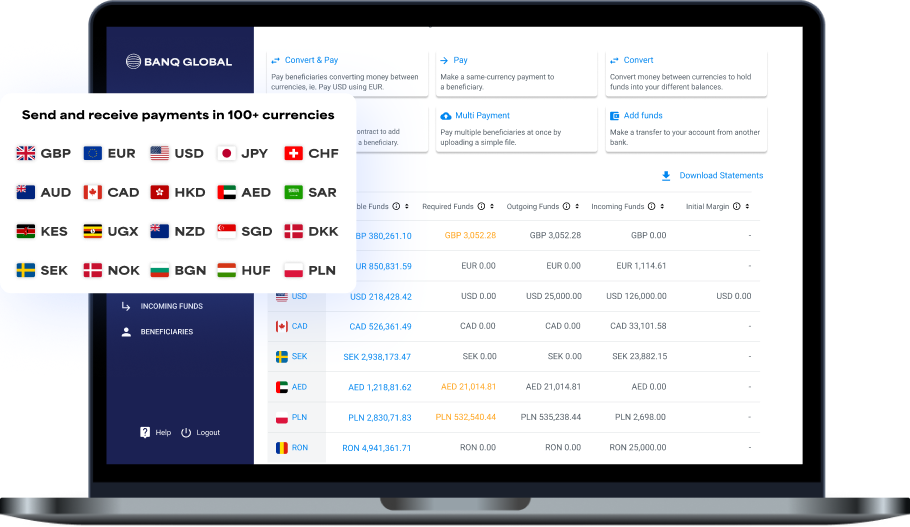
Some international businesses also choose multicurrency account providers to simplify cross-border transactions. Banq Global is a reliable option for international treasury management, offering flexible solutions for cross-border payments and multicurrency accounts.
Denmark Subsidiary Compliance and Operational Requirements
Once the subsidiary is operational with a corporate bank account, it must comply with Danish laws and regulations to maintain good standing with authorities, and avoiding penalties
VAT Registration
The Danish government requires businesses with annual revenue exceeding DKK 50,000 to register for VAT and with the Danish Tax agency, ensuring compliance with local tax regulations. By January 1, 2026, VAT-registered entities with a turnover exceeding DKK 300,000 for two consecutive years must use approved digital accounting systems.
Annual Financial Statements and Bookkeeping
Parent company's financial statements must be filed within six months of the financial year-end under the Danish Financial Statements Act (DFSA). For a December 31 year-end, the deadline is June 30. Financial records must be kept digitally for at least five years with weekly third-party backups, as required by the Danish Bookkeeping Act.
E-Invoicing Compliance
For invoicing, companies operating in Denmark are required to use approved e-invoicing formats, such as OIOUBL or Peppol, to meet local electronic invoicing standards and facilitate transactions with Danish authorities and clients.
Employee Registration and Payroll
When hiring employees, the company must register for insurance and payroll taxes. This ensures that social security contributions, tax withholding, and other legal obligations are met under Danish employment law.
Understanding Tax Environment and Incentives After Establishing a Subsidiary in Denmark
Subsidiaries in Denmark are taxed at a 22% corporate income tax rate on net taxable income (2024–2026) and are generally subject to taxation on worldwide income. Denmark also has double taxation treaties with over 90 countries, helping prevent double taxation and facilitating cross-border financial operations.
Controlled Foreign Company (CFC) rules may also apply if the subsidiary is part of a larger, controlled group, so parent companies should assess potential implications carefully. The private companies which are engaged in research and innovation can also take advantage of R&D incentives, such as accelerated deductions and innovation support, which further help in reducing tax liabilities while promoting growth.
Additionally, dividend taxation rules—particularly the general 100% exemption for dividends from subsidiaries with at least 10% ownership in EU or treaty countries—can significantly influence returns to foreign parent companies.
What Are the Key Differences Between a Subsidiary and a Branch Office in Denmark?
As discussed earlier, a subsidiary in Denmark is a separate legal entity that allows the parent company to limit its financial risk to the share capital invested. It is generally taxed on worldwide income.
By contrast, a Danish branch office is not a separate legal entity, meaning that any liabilities incurred by the branch extend directly to the parent company. Branches do not require share capital, but the parent company bears full legal and financial responsibility. For taxation, branches are typically taxed only on Danish-sourced profits.
When Should You Choose a Danish Subsidiary?
Both the branch and subsidiary can carry out the same business activities. However, a Danish subsidiary is generally preferred for long-term operations, hiring employees, or establishing offices under Danish law. It provides limited liability, formal governance through an executive board, and independent corporate reporting, supporting stronger treasury, compliance, and corporate structuring.